


Sedona Stargazing: Best Places to Experience the Night Sky

By: Adam Jerold Cansino | November 3, 2026
Sedona is famous for its towering red rock formations, scenic hiking trails, and unforgettable desert landscapes. But when the sun disappears behind the mountains, another attraction takes center stage: a spectacular display of stars, planets, and constellations.
Sedona stargazing lets visitors experience Arizona’s natural beauty after sunset. With relatively low light pollution, protected desert surroundings, and designated viewing locations, the area is one of the Southwest’s most appealing places to observe the heavens.
Whether you’re hoping to photograph the Milky Way, join a guided astronomy experience, or spend a quiet evening beneath the stars, Sedona provides several excellent options.
This guide explores the best viewing locations, astronomy tours, ideal seasons, moon phases, and practical safety tips for planning a memorable evening outdoors.
Why Sedona Is a Dark Sky Destination
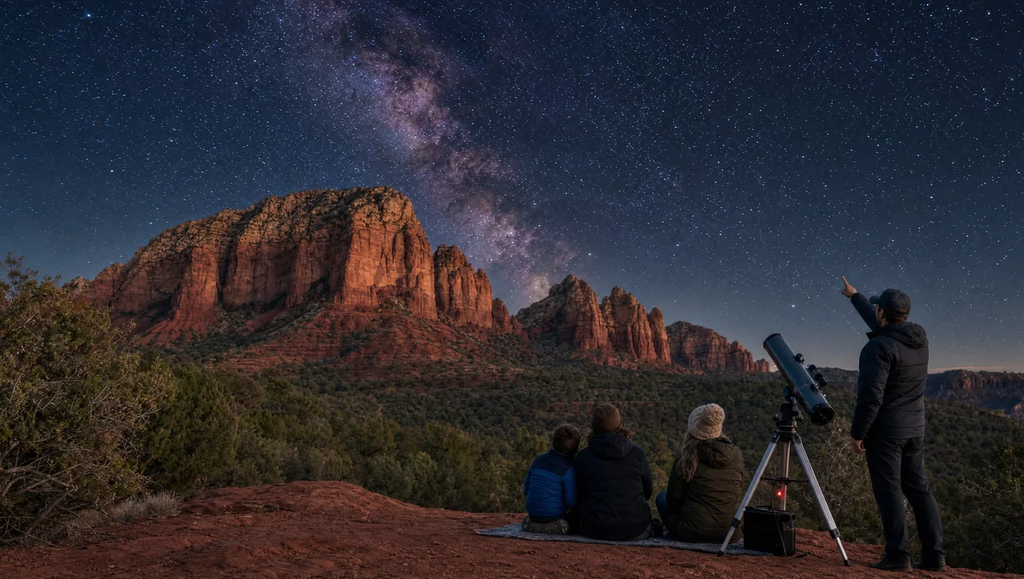
In 2014, Sedona received official recognition from DarkSky International as an International Dark Sky Community. The designation reflects the community’s commitment to responsible outdoor lighting and preserving the natural nighttime environment.
Unlike larger cities where artificial lighting obscures distant stars, Sedona’s surrounding desert landscapes provide opportunities to observe constellations, planets, meteor showers, and other celestial objects.
Several features make the destination especially appealing:
- Reduced light pollution: Community lighting practices help protect views of the stars.
- Dramatic landscapes: Red rock formations create distinctive silhouettes against the heavens.
- Multiple viewing areas: Scenic overlooks and designated trailheads offer different horizons and access conditions.
- Astronomy experiences: Professional guides introduce visitors to celestial objects through powerful telescopes.
- Year-round opportunities: Every season offers different constellations, temperatures, and observing conditions.
Sedona’s location also makes it possible to combine astronomy with outdoor exploration.
Travelers planning a longer vacation can also discover hiking, sightseeing, and other outdoor activities in our Things to Do in Sedona, AZ: 25 Red Rock Adventures and Experiences guide.
Best Places for Stargazing in Sedona
The Sedona Chamber of Commerce highlights seven stargazing trailheads and viewing areas through its Secret 7 initiative.
Each destination offers a different combination of accessibility, surrounding scenery, parking, and visibility. However, nighttime conditions vary, and visitors should verify current access rules before departing.
Centennial Trailhead: An Accessible Viewing Location
Centennial Trailhead is an appealing choice for visitors who prefer a relatively easy approach.
Located near Cultural Park Place in West Sedona, the area features a short paved trail leading toward expansive mountain views.
Its main advantages include:
- A paved route suitable for many visitors with mobility limitations.
- Scenic views toward surrounding red rock formations.
- A relatively convenient location compared with more remote desert sites.
- Opportunities to enjoy sunset before observing the stars.
The paved surface makes this location more approachable than rocky trails, although visitors should not assume every section meets formal wheelchair-accessibility standards.
For a comfortable experience, arrive during daylight, assess the walking surface, and stay within areas where nighttime access is permitted.
Beaverhead Flat Scenic Overlook: Wide-Open Desert Views
Beaverhead Flat Scenic Overlook lies south of the Village of Oak Creek, away from some of Sedona’s more concentrated development.
This scenic area offers expansive views across the Verde Valley and an unobstructed setting for observing the night sky.
It is especially attractive to photographers hoping to capture the Milky Way during favorable summer conditions.
Visitors should expect a quieter, more remote atmosphere than in central Sedona.
Because a rural road leads to the area, plan the return journey in advance and check current road and parking conditions.
Fay Canyon Trailhead: Red Rocks and Shooting Stars
The Fay Canyon Trailhead is another location featured in Sedona’s Secret 7.
The canyon entrance offers an atmospheric setting surrounded by rugged desert formations. A short walk can reveal a broader opening in the landscape, though the ground is sandy and uneven.
The location appeals to visitors interested in meteor watching, photography, or quiet observation.
Important considerations include:
- Bring a flashlight with a red-light setting.
- Avoid attempting an unfamiliar canyon hike in complete darkness.
- Remain on established routes.
- Check parking access and any applicable regulations.
Rather than exploring deep into the canyon after sunset, choose a safe, authorized observation area near the entrance.
Baldwin Trailhead: Cathedral Rock After Sunset
Baldwin Trailhead offers a memorable setting near one of the region’s best-known natural landmarks.
The area provides views toward Cathedral Rock, whose dramatic silhouette makes a distinctive foreground for nighttime photography.
The Sedona Chamber identifies a relatively short approach to a flat slickrock viewing area. However, rocky surfaces can become difficult to navigate when natural lighting disappears.
Visitors should consider arriving before sunset to become familiar with the terrain.
A Red Rock Pass or another accepted recreation pass is required for parking at this trailhead, according to the Chamber’s location guidance.
Aerie Trailhead: Quiet Desert Atmosphere
Aerie Trailhead offers views across the red rock landscape west of central Sedona.
The Chamber describes it as a location where visitors can appreciate the stars from the trailhead parking area, without needing to complete a challenging hike.
Its surroundings include distinctive formations such as the Cockscomb, which can provide beautiful scenery during twilight.
The quieter setting may suit couples, photographers, or travelers looking for an outdoor experience away from busy commercial areas.
Check road conditions and any posted restrictions before visiting, especially when returning after dark.
More Viewing Spots on Sedona’s Stargazing Map
Beyond the locations above, two additional trailheads complete the Chamber’s seven recommended sites.
Brins Mesa Trailhead is relatively close to Uptown Sedona while providing views away from some surrounding artificial lighting. The designated parking area can serve as an observation point. Visitors should use caution on the forest road section, and a Red Rock Pass is required for parking.
Thunder Mountain Trailhead offers broad views of the surrounding landscape and an appealing setting for observing stars near the trail entrance.
These locations offer alternatives for visitors who prefer a shorter drive or want to explore different scenery.
The official Secret 7 stargazing map provides helpful location information.
Remember that a location appearing on a tourism map does not eliminate parking restrictions, trail closures, or other access requirements.
Guided Astronomy Tours and Telescope Experiences
A guided astronomy experience can make an evening more educational, particularly for travelers unfamiliar with constellations or telescope equipment.
Professional guides can explain planetary movements, identify star clusters, and help visitors understand what they are observing.
Evening Sky Tours
Evening Sky Tours offers astronomy experiences in the greater Sedona area.
Its programs feature professional astronomers, guided constellation identification, and telescope observations of visible celestial objects.
The operator advertises:
- Powerful telescopes for observing planets and distant objects.
- Constellation explanations using laser pointers.
- Chairs, blankets, and warm outerwear.
- Year-round tours with seasonal starting times.
- Private tour options for small groups.
Tours take place at designated observation sites rather than in central Sedona, and guests generally drive themselves to the location.
Confirm availability, pricing, directions, and cancellation arrangements directly with the operator.
Sedona Stargazing Tours
Another established option is Sedona Stargazing Tours, listed by Visit Arizona.
This guided experience combines constellation interpretation with telescope views of objects such as planets, nebulae, galaxies, and star clusters when conditions allow.
Professional equipment reveals details that may be difficult or impossible to see with the unaided eye.
For travelers who want more than simply looking upward, a guided night tour can be a worthwhile addition to a Sedona itinerary.
Before reserving, ask about walking distances, transportation, minimum ages, weather cancellation policies, and accessibility needs.
Best Time of Year to See the Stars
The best season depends on whether you prioritize comfortable temperatures, visible celestial objects, or the possibility of seeing the Milky Way.
| Season | Typical conditions | Planning considerations |
| Spring (March–May) | Often pleasant evenings with variable winds | Bring layers and review cloud forecasts |
| Summer (June–August) | Warm evenings with opportunities to view the Milky Way | Watch for monsoon thunderstorms, especially July and August |
| Fall (September–November) | Often comfortable conditions as summer storms decrease | Expect increasingly cool evenings |
| Winter (December–February) | Cold temperatures with opportunities for clear winter nights | Wear warm clothing and check for snow, ice, or road restrictions |
Summer is particularly attractive for Milky Way photography because the bright galactic center is more favorably positioned during evening hours.
However, August falls within northern Arizona’s monsoon season, when thunderstorms can affect visibility and outdoor safety.
September can offer an appealing transition toward drier conditions, but it would be misleading to guarantee that September is Sedona’s clearest month every year.
For any season, current forecasts are more useful than relying on a general monthly average.
How Moon Phases and Weather Affect Visibility
One of the most important factors in planning a successful evening is understanding lunar illumination.
A bright moon can wash out faint stars, making the sky appear considerably less dramatic.
New Moon Versus Full Moon
- New moon: Generally ideal for observing faint stars, meteor showers, and the Milky Way because moonlight interference is minimal.
- Waxing or waning crescent: Can offer excellent dark-sky conditions depending on when the moon rises or sets.
- First or last quarter: Often useful for observing lunar surface detail while leaving portions of the evening relatively dark.
- Full moon: Makes faint celestial objects harder to see, but can illuminate the surrounding red rocks beautifully.
The moon’s position matters just as much as its phase. A bright lunar phase may still allow useful observation during hours when the moon is below the horizon.
For current information, consult NASA’s stargazing guidance and a reliable astronomical calendar.
Checking Atmospheric Conditions
Even without strong moonlight, cloud cover, haze, dust, smoke, and moisture can reduce visibility.
Before traveling to an observation site, check:
- Hourly cloud-cover forecasts.
- Wind speed and expected temperatures.
- Thunderstorm and lightning warnings.
- Smoke or haze conditions.
- Sunset, astronomical twilight, and moonrise times.
During monsoon conditions, never remain at an exposed overlook when thunderstorms approach.
A clear forecast and a favorable lunar phase provide a better foundation for a successful experience than choosing a particular month alone.
What to Bring for a Comfortable Evening Outdoors
Desert temperatures can change substantially after sunset, especially in fall and winter.
Prepare for the conditions even when the afternoon has been warm.
A practical packing list includes:
- Warm jacket, hat, and comfortable layers.
- Closed-toe shoes with reliable traction.
- Drinking water and simple snacks.
- Red-light flashlight or headlamp.
- Binoculars for observing star clusters.
- Fully charged phone with offline navigation.
- Portable chair or blanket where permitted.
- Camera and tripod for long-exposure photography.
- Small first-aid kit and backup light.
A telescope is not essential for enjoying the experience. Many constellations and brighter celestial objects can be observed without specialized equipment.
For beginners, binoculars provide a portable alternative that is easier to transport and operate.
Arriving early also allows visitors to identify safe walking areas and establish a comfortable observation position before darkness.
Responsible Nighttime Access and Dark-Sky Etiquette
Protecting the natural environment is central to maintaining Sedona’s appeal as an astronomy destination.
Responsible visitors should minimize disturbances to wildlife, nearby residents, and other observers.
Follow these practices:
- Confirm legal access. Check parking rules, entrance hours, posted closures, and recreation pass requirements before leaving.
- Stay on established routes. Avoid cutting across fragile desert vegetation or walking into unfamiliar terrain.
- Use red lighting when practical. Bright white flashlights and vehicle headlights can interrupt other visitors’ night vision.
- Keep noise low. Respect nearby residential areas and the quieter nighttime environment.
- Avoid unnecessary vehicle movement. Park only in authorized locations and never block gates or emergency access.
- Leave no trace. Remove trash and avoid disturbing plants, wildlife, and natural features.
- Avoid approaching canyon edges. Darkness makes changes in elevation and unstable surfaces more difficult to recognize.
Be particularly careful when planning activities in protected parks.
For example, Red Rock State Park is primarily a daytime destination with posted operating hours. Visitors should not assume that its trails are available for independent overnight astronomy outings.
Similarly, designated wilderness areas may have different restrictions from developed recreation sites.
Respect for the landscape helps preserve Sedona’s natural character for future travelers.
Planning an Easy Evening Itinerary
A well-organized stargazing night doesn’t need to involve difficult hiking or long travel.
Consider this simple sequence:
Late afternoon: Explore a scenic location, enjoy the surrounding landscape, and select an observation site with confirmed access.
Around sunset: Arrive at the selected location while there is enough light to assess parking, paths, and surrounding terrain.
After astronomical twilight: Allow your eyes approximately 20–30 minutes to adjust to lower light. Identify bright stars or constellations before using binoculars.
Later in the evening: Observe additional celestial objects or experiment with long-exposure photography, depending on conditions.
Before departing: Collect belongings, check that the area is clean, and return using familiar routes.
For a wider selection of evening experiences, the companion article Things to Do in Sedona at Night can help travelers pair astronomy with sunset viewpoints, dining, and other after-dark activities.
This approach keeps the evening flexible while allowing time to enjoy both the landscape and the stars.
Where to Stay for a Relaxing Stargazing Getaway
The right accommodation can make a big difference when planning an evening outdoors.
Travelers who expect to return late from an astronomy experience may appreciate having a comfortable gathering area, a kitchen, and enough space to relax after the outing.
Compared with conventional hotels, vacation homes may offer more privacy and flexible common areas for families or groups.
Paradiso Homes features luxury vacation rentals in Sedona that can serve as a convenient base for exploring the surrounding destination.
Depending on the individual property, guests may have access to spacious living areas, outdoor seating, or other amenities useful for a longer Arizona vacation.
However, outdoor amenities, unobstructed views, private telescope areas, and darkness levels vary by property, so verify them before booking.
Guests should also follow neighborhood quiet hours and any rules governing exterior lighting or outdoor spaces.
For visitors spending several days in the region, combining daytime red rock exploration with an evening astronomy experience creates a balanced itinerary.
Final Thoughts: Experience Sedona After Dark
Sedona offers far more than spectacular daytime hiking and red rock scenery. Its commitment to preserving dark skies makes the surrounding desert an inviting destination for astronomy enthusiasts, photographers, couples, and families.
From the paved approach near Centennial Trailhead to the expansive views at Beaverhead Flat Scenic Overlook, visitors can discover memorable places to appreciate the nighttime landscape.
A successful outing depends on choosing the right viewing location, monitoring conditions, understanding moon phases, and respecting local access regulations.
Whether you prefer a guided telescope experience or a quiet evening observing constellations, the stars provide another compelling reason to explore this remarkable Arizona destination.
Frequently Asked Questions
Is Sedona a Good Place to See the Milky Way?
Yes. Sedona’s dark-sky designation and nearby desert observation areas make it a promising destination for Milky Way viewing. Visibility is generally better during darker periods of the lunar cycle and in the months when the galactic center appears in the evening.
Can You Go Stargazing Without a Guided Tour?
Yes. Several scenic overlooks and trailheads are identified as astronomy viewing locations, and visitors can observe bright stars and constellations without specialized equipment. Always confirm current nighttime access, parking regulations, and trail conditions before visiting on your own.
What Is the Best Moon Phase for Stargazing?
The new moon is generally the best phase for observing faint stars and deep-sky objects because there is little lunar glare. Crescent phases can also provide favorable conditions, especially when the moon sets before the main observation period.
Is Stargazing Suitable for Families With Children?
Yes. Families can choose accessible viewing areas or guided astronomy programs designed for beginners. Shorter sessions, warm clothing, and observation locations that do not require difficult hiking are often the most practical options.
Do You Need a Telescope to Enjoy the Stars?
No. You can see many constellations, bright planets, and occasional meteors with the unaided eye. Binoculars can enhance the experience, while professional astronomy tours provide access to more powerful equipment.